
Materials for immigration work
Open and familiarise yourself with the immigration work materials.
Materials to support activities
Terminology helps in understanding immigration concepts
Words shape the way we see the world. That is why it matters how we use them. In immigration work in particular, language is constantly changing, which can make it challenging at times to know which words to use or what is being discussed.
We have compiled the key terms used in immigration work so that anyone can more easily understand what is being talked about when, for example, asylum seekers or immigrants are mentioned. The aim of the terminology is to shed light on the situations of different people who have left their home countries, as well as on the Red Cross's migration work.
We are in a constant state of learning, where the vocabulary we use also evolves and changes. Every single one of us has to update our knowledge from time to time and reflect on the words we use. Sometimes rapid changes can be confusing, and mistakes happen. When errors occur, it is important to remember that everyone makes mistakes sometimes – the most important thing then is to focus on what we can learn.
When we talk about migration, we are talking about people, many of whom are living in vulnerable situations. That is why it is important that we use language that promotes humanity and equal treatment.
You can explore the immigration work terminology in the downloadable file below (in Finnish and in Swedish).
The terminology was compiled at the beginning of 2024 – we are aware that in a couple of years, the language used in this document may already be outdated. We will strive to keep the terminology up to date as far as possible.
Termit maahanmuuttotyössä (pdf) (in Finnish)
Terminologin inom migrationsarbete (pdf) (in Swedish)
Integration is a personal process for a person moving to a new culture, during which various internal and external events and the emotions they cause fluctuate. Integration requires one's own active effort. The people around can support the integration process and open doors to local communities. Integration therefore requires a two-way approach. Getting accustomed to different customs and people takes place on both sides.
The integration timeline illustrates the stages of the integration process. You can download it in ten different languages from the bottom of the page. Use the integration curve, for example, in training and in planning activities. Share the integration curve in different languages with people going through the integration process and with the authorities and organisations working with them.
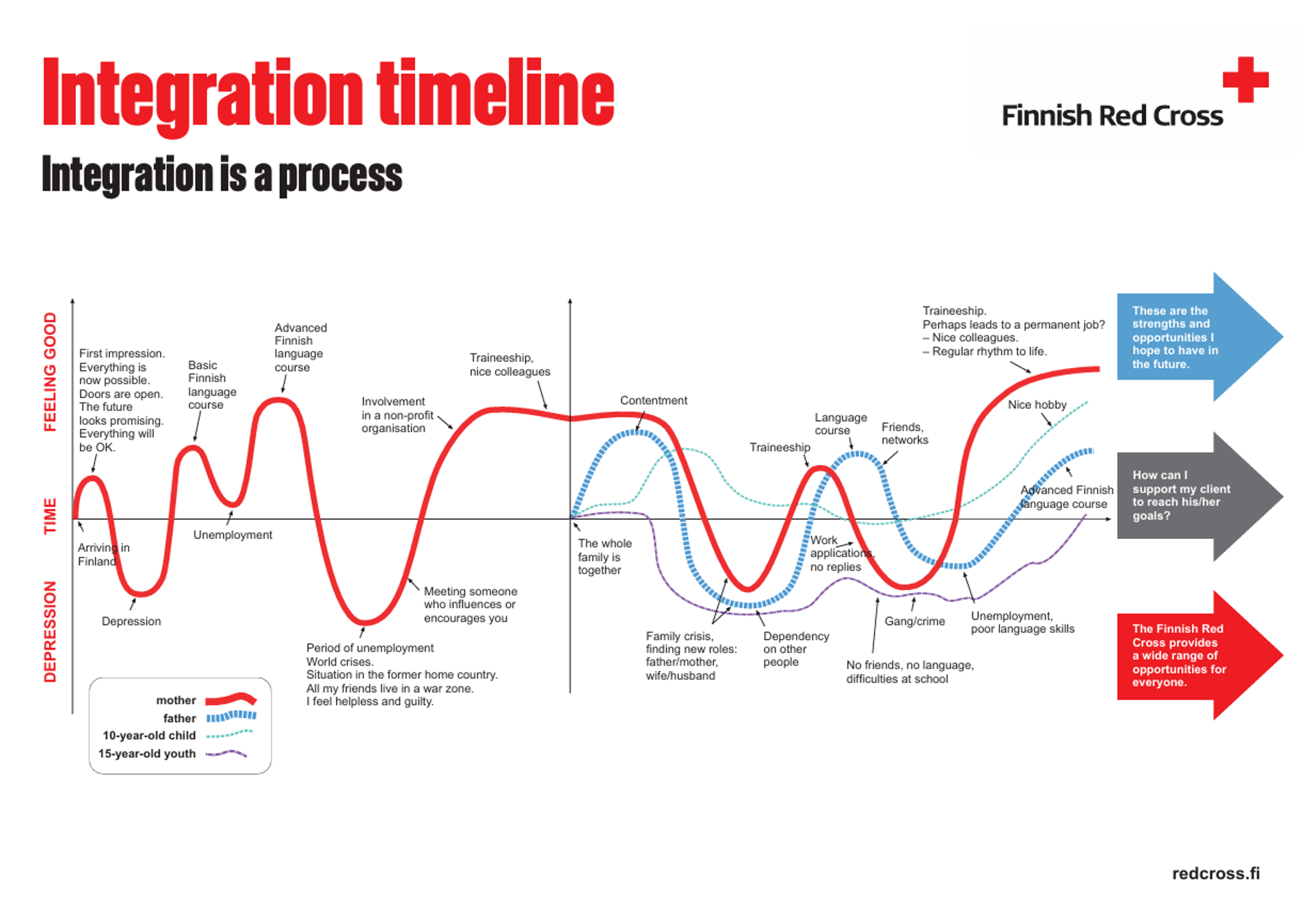
Integration timeline (pdf) in English
Integration timeline (pptx) in English
Kotoutumiskaari (pdf) in Finnish
Kotoutumiskaari (pptx) in Finnish
Integrationscykeln (pdf) in Swedish
Integrationscykeln (pptx) in Swedish
Integration timeline (pdf) in Arabic
Integration timeline (pptx) in Arabic
Integration timeline (pdf) in Dari
Integration timeline (pptx) in Dari
Integration timeline (pdf) in French
Integration timeline (pptx) in French
Integration timeline (pdf) in Russian
Integration timeline (pptx) in Russian
Integration timeline (pdf) in Somali
Integration timeline (pptx) in Somali
Integration timeline (pdf) in Sorani Kurdish
Integration timeline (pptx) in Sorani Kurdish
Integration timeline (pdf) in Ukrainian
Integration timeline (pptx) in Ukrainian
New poster templates available for use by branches! The templates allow you to edit the text details to suit the needs of your own branch, but the poster layout, image, and basic text are already prepared. The poster templates can be found under the integration support activities listed below, and they include posters both for attracting participants and for recruiting volunteers.
Take a look and start using them!
Language club (pptx)
Meeting café (pptx)
International club (pptx)
Everyday support (pptx)
Homework Help (pptx)
Introductory evening (pptx)
Join as a volunteer (pptx)
Waiting for an asylum decision in a reception centre causes stress, uncertainty, and anxiety for many asylum seekers. Exercise can increase well-being and life management, as well as strengthen self-esteem in a difficult life situation. Exercise also serves as an excellent tool for integration, getting to know one another, and building bridges. Those who exercise are on an equal footing: nationality, status, age, or background communities do not matter.
The guide available for download here brings together good practices for organising sports in reception centres. We hope that the guide will find its way especially into the hands of those reception centre employees who coordinate (or could coordinate) physical activities taking place in reception centres, as well as to those partners who organise (or could organise in the future) exercise in reception centres, for example various sports clubs, associations, employees of municipal sports departments, Red Cross branches, etc.
Here you will also find a printable black-and-white poster for providing information about sports in a reception centre. The poster presents a few sports and forms of exercise (e.g. floorball, swimming, gym, nature outing) with simple drawings, below which space has been left for e.g. a date, address, or organiser's details. The poster can therefore be completed with the necessary text and then put up on the reception centre's notice board. The poster is free to use – we hope it will be useful for communication!
Good practices for sports organised in reception centres (pdf)
Exercise poster, compilation (pdf)
Exercise posters individually (pdf)
Translation feedback
Your feedback helps us improve AI-translated pages.
Page
🔗 —0 / 500 characters
Something went wrong — please try again.
Thank you for your feedback!
We'll use it to review and improve this translation.