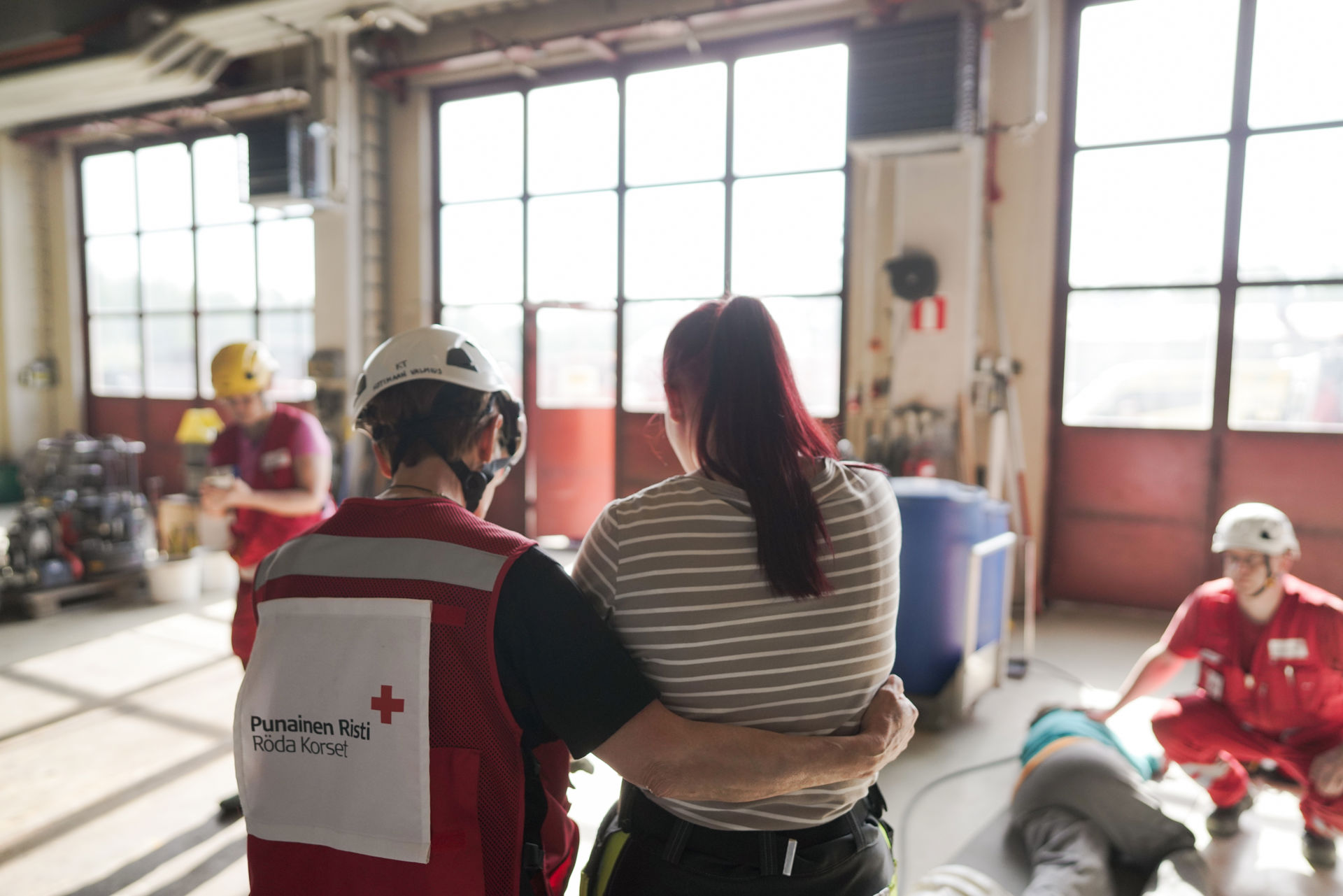
Psychosocial support – information for volunteers
In almost all Red Cross activities where people in need are met and supported, the wellbeing, mental health, resilience, and sense of community are simultaneously strengthened. It can therefore be said that psychosocial support and the promotion of mental health are present in all Red Cross activities.
Volunteers who provide emotional support or psychological first aid must have completed the Red Cross Basic Course in Emotional Support. The training teaches the principles of psychological first aid and is based on the international Psychological First Aid (PFA) training model. Volunteers from other activity areas may participate either in the basic emotional support course or in training tailored to their specific activity. It is important that as many volunteers as possible have basic knowledge of psychosocial support and of the factors that strengthen mental health.
All volunteers may need some level of competence in psychosocial support, but when more expertise is required, emotional support volunteers, the psychologists' emergency response group, and the Youth Shelters are available. They provide support to people affected by accidents and crisis situations. Help and support are also available online.
These pages provide a more detailed explanation of what psychosocial support and mental health promotion mean within Red Cross activities. They also describe how every volunteer can, through basic civic skills, provide psychosocial support and strengthen the coping ability, mental health, and wellbeing of those they support, as well as that of fellow volunteers and employees.
Psychosocial Support Handbook
In almost all Red Cross activities where people in need are met and supported, individuals’ wellbeing, mental health, resilience, and sense of community are simultaneously strengthened. Psychosocial support is therefore present in all Red Cross work. Resilience refers to flexibility, adaptation, and recovery from difficult situations.
These methods of providing psychosocial support and strengthening mental health can be learned. The most important tools are presence and listening. The Red Cross guidelines are based on the shared training materials of our international movement, and they can be adopted through basic civic skills. The aim is to create calm and psychologically safe presence.
Elements such as inclusion, agency, psychological safety, helping others, equality, humanity, volunteering, and community are central in promoting mental health and wellbeing. They are also core components of the Finnish Red Cross activities and overall preparedness, which is practiced every day.
It is important to understand which factors strengthen and which weaken mental health resources. The goal is to enhance both individual and community resilience – that is, the ability to adapt, remain flexible, and recover from difficult situations. The same things that strengthen individual resilience also strengthen communities. Likewise, a resilient community can support individuals when their own resources are low.
Mental health is similar to health in general. Mental resources can exist even in people who experience mental health disorders. It is possible to live with challenges, and mental health skills and psychological flexibility can be practiced in the same way as physical fitness.
The International Red Cross and Red Crescent Movement (IFRC) emphasizes the importance of mental health and psychosocial support (MHPSS) as part of people’s overall health and wellbeing. Mental health is viewed as a positive resource – not merely the absence of problems.
People with mental health challenges may also have significant strengths, such as a sense of humor, good relationships, and the ability to enjoy everyday life. Psychosocial support helps strengthen these resources and supports emotional resilience, especially in crises where mental health may deteriorate.
In recent years, the IFRC has increasingly highlighted the importance of psychosocial support and mental health. The Movement sees psychosocial support as essential in various crisis and emergency situations:
“Disasters and emergencies affect not only people’s physical health but also their mental health and wellbeing. Addressing global mental health and psychosocial needs is an essential part of the Red Cross and Red Crescent Movement’s work in supporting healthy communities.”
Supporting mental health is important in all everyday activities. The IFRC defines mental health in accordance with the World Health Organization (WHO):
“Mental health is a state of mental well-being that enables people to cope with the stresses of life, realize their abilities, learn and work well, and contribute to their community. It is an integral component of health and well-being and underpins our individual and collective abilities to make decisions, build relationships, and shape the world we live in. Mental health is a basic human right, and it is crucial to personal, community, and socio-economic development.”
The Finnish Red Cross bases its approach to psychosocial support and mental health promotion on international models and guidelines grounded in evidence-based knowledge. The FRC also draws on the guidance and best practices of Finnish organizations such as the Finnish Institute for Health and Welfare (THL), Mielenterveystalo, and Mieli Mental Health Finland, which rely on the same research foundation as well as Finnish studies and development work.
Below are explanations of the key terms used in the context of psychosocial support and mental health promotion. These concepts are further elaborated on other subpages.
Psychosocial Support – An umbrella term commonly used by authorities when referring to crisis work that includes:
- practical support: assessment of basic needs and the need for social services
- psychological support: empathetic presence, listening, calming verbal and nonverbal communication, remaining composed, tolerating reactions, and ensuring continuity of crisis support
- social support: community support; support and consideration for families and close relations
Red Cross volunteers provide psychosocial support using basic civic skills. Volunteers may take part in all aspects of support and assess practical needs – such as offering shelter, water, or a calm space. Volunteers also guide people forward to appropriate services whenever possible. Needs for other forms of assistance – such as social services or psychological support – are assessed by professionals and authorities.
Emotional Support – Support provided by lay helpers: individuals in someone’s social network, volunteers from various organisations, and others who are not mental health professionals – after a stressful event. This term is used within Finnish Red Cross volunteer activities. “Emotional support” is also used in everyday language and should be distinguished from spiritual support, which refers to religious aspects. Emotional support may also refer to ongoing support provided in long-term volunteer roles.
Psychological First Aid (PFA) / Emotional First Aid – A synonym frequently used in Red Cross and Red Crescent work. The Finnish Red Cross specifically uses the term emotional first aid. Both terms may appear in official guidelines. Emotional first aid is provided in acute situations, while emotional support may continue afterward and can be long-term.
Pastoral Care – A professional term used within the Evangelical Lutheran Church of Finland. Support is provided by both church employees and trained volunteers. It is similar to the Red Cross’ emergency assistance protocol. Support is offered by professionals as well as volunteers.
Mental Health Skills – Skills that help individuals maintain and strengthen their mental health and cope with life’s challenges. These skills are part of overall psychological wellbeing and relate to the ability to recognise, express and regulate emotions, solve problems, seek help, and maintain positive relationships.
Mental Health Promotion – Activities aimed at supporting and strengthening the mental health of individuals and communities and preventing mental health problems. It is part of broader health promotion and involves actions at both individual and societal levels.
Psychological Resilience – The ability of individuals, communities, and society to cope with the psychological pressures caused by crises and maintain functioning even in exceptional circumstances. It is a key component of overall societal security and resilience.
MHPSS – Mental Health and Psychosocial Support – An abbreviation used by the IFRC referring to mental health and psychosocial support. The international movement emphasizes the importance of including mental health as an integral part of psychosocial support. Good mental health is considered a resource, just like good physical health.
Resilience – The aim of Red Cross volunteer activities is to strengthen the resilience of individuals and communities both preventively and during crises. Resilience is a characteristic (flexibility, adaptation, recovery) but also a skill that can be learned and developed. It supports coping in challenging situations and helps individuals reorient themselves when circumstances change. Communities and social relationships often support recovery and adaptation – especially when individual resources are low.
Psychosocial support refers to all activities that help prevent and alleviate the effects that a traumatic event may have on people. Within the Red Cross, psychosocial support includes both crisis assistance and longer-term volunteer activities that promote wellbeing and strengthen mental health.
The aim is not only to provide help in accidents and crisis situations, but also to strengthen the resilience – meaning the coping and recovery capacity – of individuals and, most importantly, communities in advance. Psychosocial support is based on interaction and takes into account a person’s psychological, social, and physical needs in a holistic way.
The Finnish Red Cross’ approach to mental health and psychosocial support can be illustrated with a pyramid model. The model is adapted from the Psychosocial Support and Services Pyramid found in Finland’s national Current Care Guidelines (Käypä hoito), as well as the IFRC’s Mental Health and Psychosocial Support framework.
This pyramid is designed from the perspective of civic action. It does not describe or analyse the basic public service structures, which constitute a large part of the lowest level of the pyramid together with local communities and third- and fourth‑sector actors.
At the Base of the Pyramid
At the lowest level are local communities, basic public services, civic action, and all of us as individuals. If, for any reason, community support does not function or additional support is needed in everyday environments, assistance can be offered in various forms through civil society organisations.
The Red Cross provides low‑threshold support and assistance. Volunteer activities strengthen communities, promote everyday safety, and create experiences of inclusion. This builds the foundation for a resilient community that can support its members even when individuals have limited personal resources. This work can also be described as mental health promotion.
Targeted Emotional First Aid and Support (Third Level)
The third level represents situations where targeted emotional first aid or emotional support is required – support that trained volunteers are able to provide. This typically involves an accident or crisis in which authorities have requested Red Cross volunteers to assist.
Emotional first aid can also be provided without a formal request from authorities if, for example, a local Red Cross branch, alert team, or district determines that the situation requires it. Volunteers cannot enter an accident site without permission, but they may independently or jointly with other actors – such as another organisation or a parish – set up a crisis support point nearby or within the affected area. Sometimes another authority, not responsible for organising crisis services, may request help – for example youth services, a day center, or a similar unit. Emotional support may also continue after the acute situation, within everyday life.
Professional Crisis Support (Fourth Level)
The fourth level within the Finnish Red Cross refers to professional crisis assistance offered at the Youth Shelters for young people and their families. Staff members are trained in crisis work and family support. In addition, trained volunteers work alongside staff as support persons for young people and as facilitators for different group activities.
Psychologists’ Emergency Response Group (Fifth Level)
The fifth level refers to the activities of the Psychologists' Emergency Response Group coordinated by the Finnish Red Cross. The group most often provides support in major accidents where authorities require rapid additional crisis‑work capacity. These psychologists are experienced professionals in crisis and trauma work and receive compensation for their work. They can refer affected individuals to further professional care.
Increasing Severity Toward the Top of the Pyramid
The higher one goes in the pyramid, the more severe the accident or crisis, and the more targeted the support becomes. In such cases, psychosocial crisis work requires increased training, competence, and professional expertise.
The overarching goal is to strengthen the mental wellbeing and coping abilities of as many people as possible at the earliest possible stage. At the same time, the aim is to strengthen communities and support structures. A strong and resilient community can provide support when an individual's own resources become strained.
Red Cross volunteers can be alerted by authorities to support people in need during sudden events and accidents. At the Finnish Red Cross (FRC), these alert groups are called Emergency Response Units, and they support authorities – such as regional rescue services, social and crisis emergency services, or municipalities – in agreed tasks.
The purpose of FRC’s emergency response activities is to provide assistance and support in various accident and disruption situations. The volunteers involved are trained for helping tasks, and the teams practice regularly to prepare for real response situations. The FRC has its own guidelines for emergency response operations. Here, we focus briefly on the psychosocial support component of emergency response. Psychosocial support is an essential part of emergency assistance, and trained emotional support volunteers – or other volunteers with emotional support skills—should always be included in alert responses.
Emergency response supports and complements the authorities’ legal mandate
Emergency response aims to address a person’s basic needs holistically, helping them cope with the situation. Certain emergency assistance tasks may begin even without an official request, provided that Red Cross principles and guidelines are followed. It is important to note, however, that being at an accident site or supporting affected individuals directly requires permission from the authorities.
Authorities do not always think to request FRC support, so assistance may also be offered proactively. It is helpful to agree in advance who will contact the authorities, and information must flow continuously between volunteers, the local branch, and the district. It is equally important to consider beforehand what type of help will be offered and how much of it is available. Red Cross volunteers can, for example, provide conversational support in the surrounding area. Sometimes simply the visible presence of volunteers wearing Red Cross vests brings a sense of safety.
The prehospital emergency medical care provided by professionals in the wellbeing services counties is defined as “the first, urgent medical care given by a licensed healthcare professional or other trained health worker to an injured or ill person at the scene, and continued during transport.” The concept is similar to the term emergency response, but it refers to a very different type of activity. It is important to distinguish these two terms.
Support tasks may also be carried out through the Voluntary Rescue Service (Vapepa), of which Red Cross volunteer groups are a part. Assistance operations may therefore be either FRC’s own activities or part of a Vapepa mission.
FRC Psychological First Aid (PFA)
Psychological First Aid (PFA), known in Finnish Red Cross terminology as henkinen ensiapu, is one of the key tasks within emergency response. It is support provided during the first few days after a critical incident, with the aim of calming and stabilising the situation. The assistance offered includes:
- humane, non‑intrusive support
- immediate and ongoing safety, ensuring basic physical and psychological needs
- stabilising the situation, for example by providing a calm and safe space
- practical guidance and information about the situation
- assistance with family reunification
- information about common stress reactions
- support in accessing available services and support mechanisms
Red Cross volunteers can participate in all of these activities.
Psychosocial crisis support, including Psychological First Aid, can be provided by trained and familiarised:
- volunteers in Emergency Response Units (alert groups)
- volunteers in Auttava Chat, Sekasin-chat, and the Auttava Puhelin helpline
- crisis workers and volunteers at Youth Shelters and in Nettiturvis online support
During crisis situations – especially when they persist over time – additional volunteer groups may be needed, such as Friend Volunteers. Their role is to offer low‑threshold conversational support and guide individuals toward more specialised services when necessary.
FRC psychologists’ emergency response group
The Finnish Red Cross (FRC) psychologists’ emergency response group consists of experienced crisis and trauma psychologists who can be alerted according to the established alert protocol and operational guidelines. The decision to request their deployment is made by the regional social and crisis emergency services (sosiaali- ja kriisipäivystys, “sokri”) in cooperation with the regional district and the FRC national headquarters. The crisis emergency services may also request consultation from the psychologists.
In addition, the psychologists’ emergency response group may participate in post‑incident debriefings in demanding situations when commissioned by the FRC. In these cases, the assessment is made jointly by the district readiness staff, the national headquarters, and the psychologists’ emergency response group.
In major accidents or incidents resembling a large‑scale emergency, the regional social and crisis emergency services lead and coordinate the initial phase of psychosocial support activities. They also lead responses to smaller accidents, disruptions, and crisis situations. Healthcare services are primarily responsible for the psychosocial support of individuals in their care, such as injured patients.
Psychological safety is a key component of overall wellbeing, mental health, and sustaining one’s capacity to help others. In this way, psychological safety supports readiness and the ability to provide assistance. Volunteer safety is strengthened in particular through training, orientation, and agreed volunteer guidelines. These are described in more detail in the section “path to becoming an emotional support volunteer.”
Psychological safety means an atmosphere where people feel safe
It is an environment in which everyone feels able to express ideas, ask questions, raise concerns, request help, and acknowledge mistakes without fear of embarrassment, belittlement, or punishment. When psychological safety is present, we can contribute fully to shared goals while remaining open to new ideas. Psychological safety also strengthens trust in other people, the community, and society.
Psychological safety is reflected through:
- Openness in interaction – opinions, ideas and problems are expressed more freely.
- Attitudes toward mistakes and failures – in a psychologically safe community, mistakes are not held against anyone; instead, they are accepted and treated as learning opportunities.
- Respect for diversity – acknowledging and valuing differences in background, skills, and individual characteristics.
- A willingness to take risks – people are more likely to try new things when they feel safe (though risks must still be recognised and managed).
- Smooth collaboration and positive communication.
Tools the Red Cross uses to strengthen psychological safety
- Principles for safer space: The principles for safer space are based on workplace research. Extensive studies have gathered employees' views on what strengthens psychological safety in the workplace. Researchers have also observed real situations.
- Reporting tool for threatening or dangerous situations for volunteers
- Criminal background checks for volunteers working with children
- Preventing and reporting misconduct
- Prevention of sexual harassment and abuse
- Finnish Red Cross harassment contact person scheme
- Promoting equality in all activities
- Ethical and responsible Red Cross
- Youth Shelters are committed to equality
The goal of Finnish Red Cross volunteer activities is to strengthen the inclusion, functional capacity and thus the mental health and resilience of individuals and communities. These activities include, for example, friend activities, food aid, integration support activities, youth activities and Youth Shelters, online support services, Health Points and health promotion activities – such as substance abuse prevention and accident prevention – as well as helper courses and first aid group activities. A full list of volunteer activities can be found here.
Sudden crisis situations require immediate crisis support. Afterwards, people often need longer-term assistance. For example, during the COVID‑19 pandemic, FRC volunteers distributed food aid and helped elderly people in home isolation obtain food and medication together with other organisations. Online support was expanded – such as through Youth Shelters’ Nettiturvis service – and friend volunteers made regular calls when in‑person support was not possible. Volunteers have also assisted people fleeing Ukraine at airports and ports, and supported them in furnishing their new homes, managing daily tasks, and promoting mental wellbeing.
These activities are not only about recovery. Their purpose is to make daily life easier, increase meaningful experiences, strengthen a sense of agency, and thereby improve crisis resilience.
Psychosocial support can be as simple as being present in everyday situations and sharing moments with another person. Human beings have a basic need to be seen, heard, and to belong somewhere. Being present, doing things together and sharing everyday thoughts are powerful ways in which anyone can contribute to the wellbeing of those around them.
Often, people may first participate as beneficiaries and gradually become helpers themselves.
Volunteer engagement supports individuals, but it also builds stronger communities. The Red Cross’ community‑based approach helps people strengthen their own resources and later support others within their community.
The aim of FRC volunteer activities is to enhance inclusion and functional capacity, which in turn strengthens both resilience and mental health. This means supporting people in daily matters in ways that increase their own coping abilities and, ideally, connect them with a community that supports and cares for them. Over time, individuals who receive support can become active members of their new community and help others as their own resources grow.
Learning Mental Health Skills Through Everyday Activities
Within the International Red Cross and Red Crescent Movement, promoting mental health and strengthening mental health skills has become increasingly important. Alongside the term "mental health", the expression "mental wellbeing" is also used. Mental health is the foundation of wellbeing, health, and functional ability (THL). Further information on the definition of mental health can be found on the Mieli Mental Health Finland website.
The body and mind are closely connected:
- Basic needs such as sleep, exercise, and nutrition have a major impact on mental wellbeing.
- By focusing on daily routines and ordinary sensory experiences, it is possible to calm the mind and reduce stress and anxiety.
- Spending time in nature, for example, is a highly effective way to lower stress levels.
Mental wellbeing can also be supported by bringing people together and strengthening a sense of community. Emotional support volunteers can help enhance the mental support skills of other volunteers through conversations and practical exercises. To support this, Cards for a good mood have been created, providing exercises, visual prompts, and activity ideas for wellbeing‑oriented volunteering. Links to the cards are available on these pages.
The importance of inclusion for wellbeing, coping, and mental health
Inclusion means having influence over one’s life, opportunities, activities, services, and certain shared matters. Financial insecurity, poverty, and ongoing worry about money weaken both the experience of inclusion and mental health. Inclusion also means belonging and being heard. A person who feels included experiences themselves as a meaningful part of a whole, able to connect with sources of wellbeing and relationships that bring a sense of meaning to life.
Many volunteer activities teach new skills and ways to cope with everyday challenges, or provide meeting places where people can connect with others. The aim is to strengthen participants’ sense of belonging, while also highlighting practical ways to support their mental wellbeing.
Food assistance and Health Points offer concrete support, such as food or health advice. Friend visitor activities provide meaningful human connection. All these forms of support strengthen mental health, coping, and optimism for the future – especially when there is a place where help is available when needed.
Finland’s comprehensive security model means that security involves the entire society and all its actors: authorities, civil society organisations, businesses, research and education institutions, and residents. Comprehensive security concerns society as a whole.
Comprehensive security focuses on society’s crisis resilience, meaning how society prepares for, functions during, and recovers from accidents, disruptions, and crises.
In the updated comprehensive security model, psychological crisis resilience has been given a highly important role. It refers to “the ability of individuals, communities, and society to withstand the psychological pressures caused by crisis situations and maintain functioning even under exceptional conditions. It is a key part of societal security and resilience.”
Inclusion and belonging strengthen agency and psychological crisis resilience
The various forms of Finnish Red Cross volunteer activities aim to strengthen individual inclusion, functional capacity, and a sense of community. Volunteers are trained and supported, and helping activities focus on practical participation and strengthening the abilities and skills of those receiving support.
Confidence in one’s own ability to act, and trust in the functioning of the surrounding community, strengthen local resilience and psychological crisis resilience. A sense of safety arises from trust in the community and in a functioning society. Research shows that experiences of inclusion and trust also strengthen mental health and coping.
Trust is built through interaction. During the COVID‑19 pandemic, people tended to trust communication channels where interaction was two‑way, such as the social media channels of different community groups. When a community or organisation translated official messages into language and formats suited to their audience, recipients often perceived these messages as more trustworthy than one‑way official communication. People could ask questions and discuss the topic with community representatives and peers. Interaction strongly contributes to psychological safety and trust – and trust, in turn, upholds community and societal crisis resilience.
Read more about how the Finnish Red Cross strengthens psychological crisis resilience and community resilience here (in Finnish).
To become a psychological support volunteer, you first need to register in the OMA Punainen Risti system and participate in the Finnish Red Cross Basic Course in Psychological Support. OMA Punainen Risti is the platform through which volunteers sign up for activities and receive guidance for their volunteer roles.
After completing the course, you can express your interest in psychological support volunteering through OMA. If you wish to join an emergency response unit or a psychological support alert group, the unit leader will interview you and provide orientation. In some regions, these groups are coordinated by the district, and it is always advisable to contact the district’s psychosocial support lead. Volunteers in alert groups are also recommended to complete the Emergency Response and Readiness basic courses.
Not all psychological support volunteers take part in alert activities. However, it is always useful to join a local psychological support group if one exists – or consider starting one. Support is available from the local branch or district. These groups may be shared between several branches and offer opportunities to build skills, plan activities and training, and practice for support situations.
Psychological support skills are needed in all volunteer roles
If alert group work does not feel like the right fit, you can train for other volunteer roles and complete the psychological support course afterwards. Skills in psychosocial support and mental wellbeing are useful in all volunteer activities. If you want to deepen your knowledge, you can ask your local branch or district for more information.
You can also volunteer in nationally coordinated psychological support roles online. To volunteer in Auttava Chat, you must complete the Psychological Support Basic Course and the online training “Verkkoauttajana Punaisessa Ristissä”, and then join the Auttava Chat volunteer group in the OMA system.
Volunteers for Sekasin-chat are interviewed and then complete dedicated Sekasin-chat volunteer training. Before independent shifts, new volunteers practice together with a mentor. You can sign up for Sekasin-chat through OMA.
The FRC may also open the Auttava Puhelin (Support Phone Line) during major incidents. The line provides psychological support, but often primarily practical advice and guidance. The helpline is activated only when needed. If you want to volunteer, log into OMA and join the "Henkisen tuen hetu" group for more information. It is recommended to complete the Psychological Support Basic Course before joining.
At Youth Shelters, volunteers come from diverse backgrounds and can participate in many types of tasks. What unites them is an interest in supporting young people. Volunteers receive training, supervision, and continuous support from professional staff. Read more: Become a volunteer at a Youth Shelter – Red Cross
In addition to the basic course, there are many further trainings to deepen psychosocial support competence. District offices can provide information on available trainings. Psychological support volunteers can also train as trainers or as facilitators for post‑incident debriefings. See the section “Psychological support training and competence development” for more information.
Ideally, many FRC volunteers and employees should have at least basic skills in psychosocial support and mental health promotion. Most support is provided through general civic skills, but sometimes more advanced support is required, which is offered by volunteers with specialised training. In the most demanding situations, professionals provide support.
Volunteers from different activity areas often accumulate psychosocial support skills through their experience. However, psychological support volunteers have always completed the Psychological Support Basic Course, which covers Psychological First Aid (the Hobfoll model and its principles).
It is important to remember that we can provide support spontaneously during incidents – simply being present matters. While entering the accident site requires permission from authorities, volunteers can set up a nearby space where anyone can talk and process their feelings.
Psychosocial support is relevant in many everyday situations – not only in accidents or crises. Below are some examples of where psychological or psychosocial support from volunteers may be needed:
|
Psychosocial support
|
Emotional support (psychological support volunteers or trainers)
|
|
Everyday volunteer activities: friend activities, food assistance, integration support, health promotion
|
Everyday volunteer work, supporting other volunteers
|
|
Supporting a community by offering a safe space for conversation – often with coffee, tea, juice, or snacks. Volunteers may come from psychological support, food aid, friend activities, health promotion, or migration support.
|
Supporting authorities when requested |
|
Online support in everyday life (online friend activities, SekasinChat)
|
Auttava Chat and Auttava Puhelin during crises
|
|
Sharing information about mental health in everyday volunteer settings, e.g., info sessions at community spaces
|
General information sessions during crises to calm people and provide coping guidance
|
|
Debriefing discussions for volunteers
|
Debriefing sessions, including support for other volunteers
|
|
Public training in everyday settings
|
Public training during crises, e.g., webinars for parents
|
Examples of volunteer activities requiring different levels of psychosocial support skills
Psychological support groups and alert groups: These activities focus mainly on assisting in crisis situations. They typically involve sudden events where psychological support volunteers are needed to provide psychological first aid, calming the situation, listening to people’s concerns, offering accurate and timely information, and guiding individuals to further support. Psychological support may continue for some time after the immediate crisis.
Requirements: completion of the Psychological Support Basic Course and orientation to alert group operations. The groups train regularly. More information is available in the section Crisis response and emotional support.
Post‑task debriefings: Psychological support volunteers (who have completed the basic course and have demonstrated sufficient experience or competence) can train to become defusing facilitators. They organise debriefing discussions after alert missions or after long‑term volunteer tasks. Debriefings are useful even when nothing visibly severe has occurred, as volunteers benefit from processing experiences in a guided setting.
Youth Shelters: Youth Shelters support young people both online (Nettiturvis) and at five regional centres: Western Uusimaa, Helsinki, Vantaa–Kerava, Pirkanmaa, and Southwest Finland. Read more about volunteering at Youth Shelters.
Sekasin-chat: Sekasin-chat is operated by several organisations and offers a safe space for young people to talk with a trusted adult. You can sign up as a volunteer here.
Online support: The Finnish Red Cross has several online volunteering options. Not all require the Psychological Support Basic Course, but completing it is recommended for anyone who wants confidence in support situations.
Read more.
Auttava Chat and Auttava Puhelin (Support Phone Line): These services open during major emergencies when people need someone to talk to and require reliable guidance. They are not active continuously, so anyone wanting regular volunteer work is encouraged to join other activities as well. Volunteers interested in Auttava Chat can also join the open volunteer group in OMA Punainen Risti.
Friend activities: Friend volunteers meet people in many different life situations, including individuals experiencing loneliness, depression, poverty, or mental health challenges. Psychological support competence is very valuable in these encounters.
Recommended training: Psychological Support for Friend Visitors and Food Aid Volunteers (3 hours, currently available in Finnish and Swedish).
Food assistance: Volunteers often encounter people who struggle with financial hardship. Poverty and financial insecurity are known to weaken mental health, which makes psychological support skills particularly useful.
Training available: Psychological Support for Friend Visitors and Food Aid Volunteers (3 hours, currently available in Finnish and Swedish).
Migration work: Volunteers supporting migrants often meet people living in prolonged crisis situations. The Finnish Red Cross offers training on providing psychological support to vulnerable migrants. Volunteers learn practical ways to support people facing especially difficult circumstances.
Information on these trainings is available in OMA Punainen Risti.
More information on mental wellbeing of migrants is available at THL’s website.
Health Points: At Red Cross Health Points, volunteers provide health advice and often encounter situations where psychological support skills and mental health literacy are beneficial. Psychological support competence is also valuable in first aid activities and readiness operations.
Health promotion volunteers: Health promotion volunteers conduct outreach substance abuse prevention work, for example at festivals, events, and schools. They meet people in a wide range of situations, making psychological support skills essential.
All our volunteers commit to upholding the principles that guide the work of the Red Cross and Red Crescent Movement. These principles should be read before applying to volunteer activities. Read more about the principles here.
General rules for volunteering
These guidelines are adapted from the rules of friend activity. Various practical instructions can be found here.
Ordinary skills
Red Cross volunteers support others using ordinary, everyday human skills and resources. Volunteers do not perform the duties of professionals, even if they personally have such expertise. Psychological support volunteers carry out the tasks assigned to them, for example during an alert mission. Key tasks for psychological support volunteers can be found here.
Volunteering is unpaid
Volunteer work is always unpaid. Some expenses may be reimbursed if agreed upon in advance. Read more here.
Voluntary Participation
Everyone participates voluntarily, based on their own motivation. Each person may choose a role that suits them and decide how much time to dedicate. Volunteers may choose tasks that bring them joy and fulfillment, and they may change roles if they wish. Everyone has the right to say “no” to any request or task that feels too demanding, inappropriate, or uncomfortable.
Reliability
A volunteer is reliable. Even though volunteers are not employees, they are expected to fulfill the commitments they have made. Volunteers must take care not to promise more than they can realistically manage. In friend visitor activities, reliability means keeping to agreed tasks, schedules, and meeting times. If changes arise, they must be communicated politely and in advance.
Confidentiality (including social media!)
As a Red Cross volunteer, you are bound by confidentiality. Activities are confidential for both parties, and volunteers must not share information about the people they help without explicit consent. If a volunteer encounters a problem situation, they have both the right and the obligation to consult with professionals – they do not carry responsibility alone. Matters may also be discussed confidentially within the psychological support team or among those involved in the specific activity.
Neutrality
The primary task of the volunteer is to support and listen. When difficulties arise, volunteers can help the person explore solutions, but they do not take sides or intervene in conflicts between others. According to the principle of neutrality, the organisation does not take positions on matters such as religion or politics. In volunteer activities, help is provided to those most in need, regardless of worldview, religion, language, or skin colour.
Working on the terms of the person needing support
Support is given on the terms of the person receiving help. Volunteers must respect the individual’s autonomy and right to self‑determination. A volunteer cannot make decisions on behalf of someone else but walks beside them, listens, and supports.
Equality
As a volunteer helper, you are equal to the person you support, even if they need your assistance. Volunteers also meet one another as equals. Every participant is valued and respected as they are, and everyone’s thoughts are taken seriously.
Joy of volunteering
Volunteering should generate joy and positive experiences for everyone involved. The activity is shared, voluntary, and positive in nature. It should not become an unpleasant obligation – it should bring satisfaction to all parties. Volunteers may end their role whenever they choose.
Volunteers have the right to:
- experience joy and gain new skills
- participate in roles for which they have interest and competence
- receive orientation, training, guidance, and support, including peer support, shared events, supervision, and mentoring
- take part in planning and developing activities
- participate in statutory decision‑making if they are members
- give and receive feedback and appreciation
- feel valued for their contribution
- grow as volunteers and receive a certificate if desired
- receive reasonable reimbursement for expenses arising from volunteering (according to the volunteer expense reimbursement guideline).
Volunteers have the responsibility to:
- act according to the values and principles of the Red Cross
- follow the organisation’s rules and operational guidelines
- ensure activities are safe for all. Racism, discrimination, and harassment are not tolerated
- intervene immediately if they witness discrimination or racism
- commit to the tasks they have agreed to – this helps the organisation plan and deliver its activities effectively
- participate in relevant orientation and training
- report any deficiencies or risks they notice
- adhere to confidentiality and data protection guidelines.
More information on volunteering in Finnish Red Cross can be found here.
During accidents and crisis situations, everyone’s mental wellbeing is strained, and trained volunteers can help others get through the most difficult moments. Psychological support volunteers are often also trained to facilitate defusing sessions. These sessions are needed after volunteer tasks, especially alert missions. Online support work also requires regular debriefings to ensure that volunteers have the emotional resources to continue.
Many volunteers want to talk and reflect on their experiences with other volunteers. Local branches or volunteer groups should therefore arrange regular sessions where volunteers can share experiences and emotions. It is important to agree on rules about discussing sensitive matters, such as whether real names may be used. Periodically, a trained defusing volunteer should be invited to lead these conversations.
The foundation of volunteer wellbeing includes:
- sufficient training and orientation,
- a clear task description,
- support from the local branch or activity group,
- ongoing competence development, and
- commitment to shared principles and practices.
Everyday interaction in volunteer groups should never be forgotten. Ordinary peer‑to‑peer conversations are essential for volunteer wellbeing. These conversations do not always need to address difficult issues – sharing successes and moments of joy is just as important. Celebrating achievements and expressing appreciation strengthen the entire group.
All volunteer support tasks should be discussed
As helpers, we focus on supporting others, and can easily overlook our own wellbeing. An exhausted helper cannot help others effectively. This is why volunteers should regularly reflect on their experiences and feelings with fellow volunteers. The Mood Sharing Round is intended to be an easy, routine way to talk about how one is feeling in relation to the task.
Mood Sharing Round to support volunteer wellbeing
The Mood Sharing Round is a simple and routine method to look after the wellbeing of volunteers. The material available here describes how to conduct a Mood Sharing Round after each activity session, how it supports emotional recovery, and when additional support should be sought.
The Mood Sharing Round is suitable for anyone involved in volunteer work. Red Cross local branches are encouraged to make it a regular practice. It is especially recommended for volunteer leaders, such as group coordinators and facilitators.
The Mood Sharing Round aims to:
- show care for volunteer wellbeing
- normalise the emotions, thoughts, and reactions that may arise during or after volunteering
- train volunteers to talk about their experiences
- help volunteers appreciate their own and others’ feelings and thoughts
- teach when additional support is needed
Crisis volunteering in accident and disaster situations is emotionally demanding. Helpers may experience similar reactions and emotions as those they support, and defusing conversations are necessary for coping.
Defusing sessions
A defusing session should be organised whenever a situation may cause psychological stress for volunteers or hinder their return to everyday routines.
The purpose of defusing is to quickly reduce acute stress reactions, normalise experiences, strengthen social support, and prevent isolation. The goal is to enable volunteers to return to their routines as quickly and smoothly as possible. Defusing also helps to assess whether a later debriefing or individual support is needed.
After defusing, a professionally led debriefing session may be organised, where the incident is processed in greater depth. Several sessions may be arranged if needed. A debriefing facilitator (a psychologist) can be requested through the FRC psychologists’ emergency response group. Districts should also establish cooperation with regional crisis services or crisis centres, especially when a psychologist is not available through the FRC.
Defusing sessions must be requested from the district office, typically from the psychosocial support lead, the preparedness manager, or the organisational development officer. Volunteers should familiarise themselves with their district’s procedures in advance.
Difference between defusing and debriefing
Within the Finnish Red Cross, defusing refers to a short, immediate conversation designed to reduce psychological strain and restore functioning after a sudden or distressing event. Defusing sessions can be led by trained FRC volunteers, ideally conducted within 8–12 hours of the event.
Debriefing refers to professionally facilitated group sessions, where participants may share their perspective on the event and their emotional reactions. Debriefings are typically arranged 1–4 days after the traumatic event, and sessions may be repeated as necessary. Debriefing has a structured format and focuses on emotional processing. It is especially beneficial for individuals who react strongly to an event.
Timely psychological support helps people move forward when a sudden and unexpected crisis shakes their sense of safety. Everyone encounters situations in life that feel overwhelming. A crisis may be caused by, for example, a breakup, unemployment, illness, the death of a loved one, an accident, or being a victim of a crime.
An acute crisis is a sudden and shocking event – such as the unexpected death of a loved one, an accident, or violence – that rapidly disrupts a person’s sense of safety.
A life crisis is a broader term referring to challenging life changes, such as divorce or unemployment, which may develop gradually and create long‑lasting strain. While both are forms of crisis, an acute crisis describes a sudden, often traumatic event, whereas a life crisis may be long‑term or develop slowly over time.
Phases of a crisis
Each person experiences a sudden crisis differently, but many crises follow recognizable patterns. These phases are not rigid, nor do all people go through them in the same order or in the same way. However, certain reactions commonly occur.
Shock phase
The shock phase begins immediately after the event and lasts up to a few days. The person may not yet grasp what has happened. Typical reactions include unusual calmness despite the severity of the event, panic or agitation, or complete emotional numbness or paralysis. The purpose of this phase is to protect the mind from information it cannot yet process.
Reaction phase
This phase typically lasts from a few weeks to several months. The person gradually becomes aware of what has happened and what it means. Common reactions include strong emotions such as guilt, anger, and crying, or physical symptoms such as nausea, dizziness, or sleep disturbances. In this phase, a person usually has a strong need to talk about the experience with others.
Processing phase
This phase may last from several months up to a year. During this time the actual grieving process begins and the person slowly begins to accept the loss or event. Memory or concentration difficulties may occur and the person may withdraw socially.
Reorientation phase
In this phase, the crisis gradually becomes part of the person’s life story. Signs of recovery include return of joy and interest in life, and increased strength and coping capacity.
Recovering from a crisis
People have different levels of readiness and resources for handling difficult life situations. One person may cope relatively quickly on their own, while another may need more time and support.
Recovery is affected by factors such as the nature of the crisis, one’s life situation before the crisis, and levels of stress, resources, and social support
If life has already been stressful, coping with a new crisis will be more difficult. Old, unresolved crises may also resurface during an acute crisis. A new crisis can provide an opportunity to process and heal older emotional wounds.
Source: Mielenterveystalo.fi – Kriisin vaiheet ja kriisistä toipuminen (Phases of a crisis and recovery, in Finnish. Accessed 8 Dec 2025)
Also see: MIELI Mental Health Finland – Shokista uuteen alkuun (From shock to a new beginning, in Finnish. Accessed 8 Dec 2025)
Psychological first aid
Psychological first aid is a skill that can be learned just like any other first aid skill.
By recognising your own and others’ crisis reactions, seeking help, and familiarising yourself with psychological support guidelines, you can help yourself and others cope with crises.
Read more: How to help yourself or your loved one in a crisis – Finnish Red Cross
The Finnish Red Cross psychologists’ emergency response group operates on the basis of a cooperation agreement between the Finnish Red Cross and the Ministry of Social Affairs and Health, updated in 2024. The agreement states, among other things, that the Finnish Red Cross maintains a psychologists’ emergency response group for crisis and accident situations.
The group consists of 25 psychologists from across Finland. In crisis situations, the psychologists’ emergency response group can be alerted through the Finnish Red Cross.
After an alert, a core team – comprising Finnish Red Cross staff and members of the response group – assesses the need for psychosocial support and the scale of the operation. Together with the authorities, they prepare a plan for personnel deployment and the duration of support activities.
Outside crisis situations, various organisations may request the group to provide training, consultation, or debriefing services.
Being on standby for the group is voluntary and is not financially compensated. When carrying out assignments commissioned by the Finnish Red Cross, group members receive compensation for their professional work. Cost arrangements with the requesting organisation are agreed upon separately. Basic operational costs of the group are covered by the Finnish Red Cross Disaster Relief Fund.
Read more: What is the Finnish Red Cross psychologists’ emergency response group? (available in Finnish and Swedish)
When communicating about accidents or crises in which Finnish Red Cross volunteers are involved, it is essential to remember that authorities are responsible for communicating about the incident itself. The Red Cross communicates only about its own activities, not about the accident, disruption, or crisis itself.
Local branches and volunteer groups are encouraged to train in emergency communication and to designate a person responsible for communications in advance. This allows one person to focus on communications during an incident. Communication must activate immediately, as soon as something happens. It is also important to inform the district about the situation without delay.
The communications team at the national headquarters supports branches and districts during crises and assists in liaising with the media and journalists. It is especially important that branches and districts can identify situations likely to attract media attention. Volunteers are encouraged to contact the headquarters’ communications team for support, even at an early stage.
During crisis situations, urgent updates about Red Cross activities are shared online through the organisation’s website and social media channels (Facebook, Instagram). Press releases can be issued for both regional and national media.
Dedicated crisis webpages can be created quickly to provide contact information for psychological support (e.g., crisis helplines, organisational contact persons), situation‑specific information, and practical guidance for psychological support.
Read more about communication: Volunteer communications
In addition to the Basic Course in Psychological Support, the Finnish Red Cross offers several other trainings that deepen psychosocial support skills. Below is a list of courses delivered by our volunteer trainers. We also periodically offer joint webinars on topical themes.
All volunteers are welcome to participate in psychological support trainings. These courses provide tools for encountering people in helping situations. In emergencies, psychological support skills become particularly important. Training offerings can be found on the OMA Punainen Risti site.
We recommend that all aspiring volunteers begin with the “Welcome to the Red Cross” online course (30 minutes).
You can access the course here.
Additional introductory materials about the Red Cross can be found here.
Psychological support trainings
Basic course in psychological support, 8 hours
Focuses on Psychological First Aid (PFA) – a simple yet powerful method for helping people in distress. The course emphasises recognising reactions, active listening, and supporting people in addressing immediate problems and basic needs. Learning psychological first aid skills and understanding crisis reactions enables volunteers to help both others and themselves in crisis situations.
Advanced course in psychological support, 8 hours
Deepens psychosocial support skills and offers more knowledge about stress, its causes, and ways to relieve it. The course also covers grief, mourning, and providing psychological first aid to grieving individuals. Participants learn how traumatic events affect communities and how to strengthen both community and individual resilience.
Psychological support basic + advanced online courses, 8 hours
The same content as in the classroom versions, offered online.
Psychological support for friend activity and food aid volunteers, 3 hours
Provides foundational knowledge of psychological support and prepares friend visitors and food assistance volunteers to meet people in diverse life situations. The course also gives tools for protecting one’s own wellbeing and setting boundaries. Includes case exercises and peer discussion.
This course should be completed only after the basic trainings for friend activity or food aid volunteers.
Youth and mental Health – supplementary training material, 2 hours
For volunteers who work with young people (e.g., in friend activities, group activities or online support).
Can be completed independently through FRC learning materials or in a facilitated classroom session.
Mental health for volunteers – supplementary training material, 2–3 hours
Designed for all volunteers who encounter mental health challenges in their tasks.
Originally built for friend activity and food aid volunteers, but this is suitable for others as well.
Psychological support for migrants in vulnerable situation, 3 hours
For volunteers working with migrants exposed to vulnerabilities (e.g., asylum seekers, temporary protection beneficiaries, undocumented persons, victims of trafficking, unaccompanied minors, detainees). Covers basic psychological support from a migration perspective and recognising vulnerabilities.
This course should be completed only after the Integration support or Psychological support basic course.
Psychological first aid for children, 8 hours
This course follows the same principles as psychological first aid for adults, but children are not “small adults” – they may need different kinds of protection and care. The course teaches child‑appropriate psychological support skills.
Psychological first aid for youth, 8 hours
Available in Spring 2026.
Defusing training, 3h + 8h + 3h self‑study
Experienced and trained volunteers may lead defusing sessions after demanding assignments.
The training is available to experienced psychological support volunteers who have completed the Basic course. Training consists of 3 hours online training, 3 hours of self‑study, and 8 hours classroom training.
Trainings for online support volunteers:
Online helping in the Red Cross, 2 hours
An independent online course providing basics of online encounters and safe digital volunteering. Together with the Psychological support basic course, it forms the foundation for volunteers in Auttava Chat.
Sekasin-chat volunteer training, 8 hours
Independent online training on youth mental health, online interaction, and practical chat support skills.
Psychological support “trigger infos”
Available in 2026.
Mental health skills trainings
Available in 2026.
Volunteer trainers deliver basic and advanced training to Red Cross volunteers and external groups. Trainers are selected by the district or local branch. They receive preparation that emphasises both subject‑matter expertise and alignment with Red Cross values and principles, as well as developing personal training skills.
The trainer role requires an interest in working with people, strong interpersonal skills, the ability to learn and facilitate learning, and the ability to motivate and inspire others. Applicants must also be at least 18 years old and have completed the basic course in their respective field.
Psychological support trainers train Red Cross and Voluntary Rescue Service volunteers, the public, and – when needed – staff in organisations and companies. They may also support districts and branches as psychological support specialists.
You are suitable for this role if you believe psychological support belongs to everyone, have relevant professional or volunteer experience, and wish to share your expertise.
How to become a trainer
You can apply for trainer training through your district office. Training paths and future tasks are agreed with the district training or programme coordinator.
Trainer training includes remote and in‑person modules and a supervised teaching demonstration.
Trainer qualification and validity
Trainer qualification is granted after completing all training modules and the teaching demonstration (approx. 2 x 45 minutes). The demonstration should be completed soon after the final module of trainer training and conducted as part of a basic course in the relevant training line. Trainer qualification is valid for three years from the teaching demonstration or from completing supplementary training. National trainer refresher training is held annually during the second‑to‑last weekend of January.
Certificate and trainer card
Trainer qualification is granted by the district programme or organisational staff member responsible for the relevant training line, who signs the certificate (alone or together with the district training lead or director). Trainers may also request a personal trainer card with a photo. The trainer training programme corresponds to 4 ECTS credits, with a detailed content description provided as a certificate attachment.
Translation feedback
Your feedback helps us improve AI-translated pages.
Page
🔗 —0 / 500 characters
Something went wrong — please try again.
Thank you for your feedback!
We'll use it to review and improve this translation.